

Joyce Mmereole Okoli
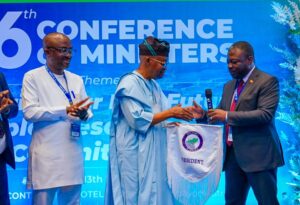
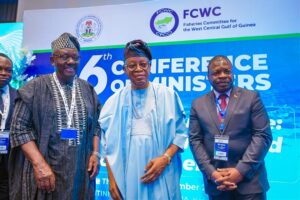
Nigeria’s Minister of Marine and Blue Economy, Dr. Adegboyega Oyetola, CON, has been unanimously elected Chairman of the Conference of Ministers of the Fisheries Committee for the West Central Gulf of Guinea (FCWC), marking a new era of leadership and regional solidarity in the subregion’s blue economy and fisheries governance.
The election took place on Thursday during the 16th Conference of Ministers of the FCWC, hosted by Nigeria at the Lagos Continental Hotel, Victoria Island, Lagos. The three-day ministerial meeting brought together Ministers of Fisheries, Maritime Affairs, and Blue Economy from Benin, Côte d’Ivoire, Ghana, Liberia, Nigeria, and Togo, as well as regional and international partners, to deliberate on strategies for deepening cooperation, tackling illegal fishing, and promoting sustainable ocean governance.
With his election, Dr. Oyetola succeeds Liberia as Chairman, assuming the responsibility of steering the policy direction of the FCWC Conference of Ministers the highest decision-making organ of the body for the next two years.
Declaring the Conference open on behalf of President Bola Ahmed Tinubu, GCFR, Dr. Oyetola called for renewed regional collaboration and commitment** to securing the Gulf of Guinea and unlocking the vast opportunities of the blue economy for inclusive and sustainable growth across West and Central Africa.
“This Conference provides an invaluable platform to reflect on our stewardship of the marine environment, confront emerging challenges, and chart a renewed course for sustainable ocean governance,” he stated.
He emphasized that the health, security, and productivity of the Gulf of Guinea’s waters are critical not only to the livelihoods of millions across member states but also to the region’s collective prosperity.
“We must recognize that the ocean is our shared heritage and our shared responsibility. The time has come for us to move from dialogue to decisive action to strengthen surveillance, improve governance, and create sustainable opportunities from our marine resources,” the Minister said.
The FCWC, established in 2007 under the auspices of the Food and Agriculture Organization (FAO), serves as a subregional platform for coordination, cooperation, and joint action among member states on issues of fisheries management, maritime security, and blue economy development.
Oyetola highlighted that the growing threats of illegal, unreported, and unregulated (IUU) fishing, pollution, climate change, and maritime insecurity have continued to undermine the region’s food systems, economies, and environmental integrity.
“These are challenges no nation can overcome in isolation, They demand sustained regional collaboration, political will, and shared responsibility. We must build on the gains of our joint patrols, data sharing mechanisms, and collective enforcement strategies to ensure the long-term sustainability of our marine resources,” he stressed.
Speaking on the Conference theme, “Securing Our Ocean Future: People, Resources, and Commitments,” Oyetola described it as a timely call to action for governments, institutions, and stakeholders to harmonize marine resource conservation with economic transformation goals.
He reiterated that under President Tinubu’s Renewed Hope Agenda, the marine and blue economy has been repositioned as one of the key drivers of national growth, with the potential to contribute significantly to job creation, food security, and foreign exchange earnings.
“Our goal is to build a blue economy that creates jobs, secures food supply, promotes investment, and drives sustainable national growth,” Oyetola declared.
He explained that Nigeria’s ongoing reforms in the marine and blue economy sector include:
• Strengthening institutional coordination among maritime agencies.
• Enhancing maritime domain awareness and security infrastructure.
• Modernizing port operations and logistics efficiency.
• Expanding aquaculture and artisanal fisheries development.
• Promoting private sector participation and foreign investment.
• Building climate-resilient coastal communities.
He reaffirmed Nigeria’s commitment to joint regional surveillance patrols, intelligence sharing, and harmonized enforcement mechanisms to tackle IUU fishing, piracy, and transnational crimes across the Gulf of Guinea.
“Our cooperation is our greatest strength, we must continue to act together, invest in modern monitoring technologies, and sustain our partnerships to safeguard the future of our shared waters,” the Minister emphasized. “
Following his election as Chairman of the FCWC Conference of Ministers, Dr. Oyetola pledged to consolidate regional partnerships and promote practical frameworks for collective action, institutional strengthening, and capacity building.
He commended the FCWC Secretariat, led by Secretary General Mr. Gaston Djihinto, for its tireless efforts in coordinating subregional fisheries policies and driving donor-supported initiatives that have enhanced data sharing, surveillance coordination, and governance alignment among member countries.
Oyetola also praised international development partners and agencies, including the Food and Agriculture Organization (FAO), World Bank, World Health Organization (WHO), Blumbergers, and the Fisheries Sector Association for their technical and financial support towards advancing sustainable fisheries management and maritime safety.
“Nigeria remains committed to providing the leadership required to sustain the momentum.Together, we will strengthen the foundation of the FCWC and ensure that our policies translate into real benefits for our people,” he affirmed.
In his remarks, FCWC Secretary General Mr. Gaston Djihinto commended Nigeria for hosting the 16th Conference and for demonstrating unwavering leadership in championing the cause of sustainable fisheries and ocean governance in the Gulf of Guinea.
He described the annual ministerial conference as a strategic forum for reflection, consultation, and decision-making, aimed at consolidating progress on fisheries management, food security, and socio-economic growth within the subregion.
Djihinto emphasized the need for continued collaboration among member states and their partners to strengthen the operational capacity of the FCWC Regional Monitoring, Control, and Surveillance (MCS) Centre, which serves as the hub for real-time tracking of fishing activities and enforcement coordination.
“Our unity and shared vision are the pillars of our progress,” Djihinto noted. “The resolutions from this 16th Conference will mark a turning point in deepening regional cooperation and securing the sustainable use of our ocean resources.”
The outgoing FCWC Chairman and representative of Liberia, Mr. Cyrus Saygbe, in his goodwill address, commended the subregion for its achievements under Liberia’s leadership and expressed confidence in Nigeria’s capacity to build on those successes.
Saygbe highlighted the urgent need for digital transformation and technology-driven governance in the fisheries sector, calling for the deployment of satellite-enabled vessel tracking systems, electronic licensing, and real-time monitoring tools to improve transparency and accountability.
“We must adopt digital vessel tracking, satellite surveillance, and real-time monitoring systems these are essential tools for sustainable fisheries governance,” he stated.
He announced ongoing efforts to establish a joint maritime patrol involving Liberia, Nigeria, and Côte d’Ivoire, to be coordinated through the FCWC’s MCS Centre, describing it as “regional solidarity in action.”
Saygbe also urged governments and investors to channel resources into aquaculture development, noting that the sector holds enormous potential for ensuring food security, creating youth employment, and building resilience against climate change.
“Aquaculture is no longer an alternative, it is our most promising path to prosperity,” he emphasized.
He concluded by calling for the accelerated implementation of the **Monrovia Declaration** and the adoption of innovative financing models to sustain regional cooperation and project execution.
Throughout the Conference, delegates and partners engaged in technical and policy sessions focused on deepening regional collaboration, strengthening fisheries governance, improving maritime domain awareness, and unlocking the full potential of the Gulf of Guinea’s blue economy.
The sessions also explored sustainable investment pathways, ecosystem management, capacity building for coastal communities, and gender-inclusive approaches to blue economy development.
Declaring the Conference open, Dr. Oyetola invited participants to experience the “vibrant energy and maritime dynamism of Lagos”, describing the city as Nigeria’s maritime gateway and a hub of innovation and opportunity.
“As we gather here in Lagos the heartbeat of Nigeria’s maritime industry let us be inspired by its energy, diversity, and resilience. Together, we can build a Gulf of Guinea that stands as a beacon of sustainable growth and regional integration,” he said.