

Joyce Mmereole Okoli
Nigeria’s Minister of Marine and Blue Economy, His Excellency Adegboyega Oyetola, CON, has declared that the era of classifying Nigeria as a high-risk maritime zone is over, insisting that the war risk insurance premiums imposed on vessels bound for the country must be scrapped.
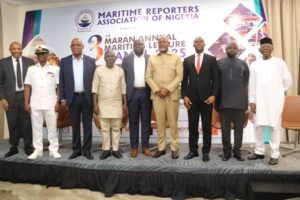
Speaking at the 3rd Annual Maritime Lecture of the Maritime Reporters Association of Nigeria (MARAN), held on Wednesday at Four Points by Sheraton, Victoria Island, Lagos, Oyetola represented by his Special Adviser on Media and Communications, Dr. Bolaji Akinola described the continued surcharges as outdated, unjust, and detrimental to Nigeria’s economic growth.
The Minister pointed to Nigeria’s remarkable progress in maritime reforms and security, stressing that the global perception of Nigerian waters as unsafe no longer reflects reality.
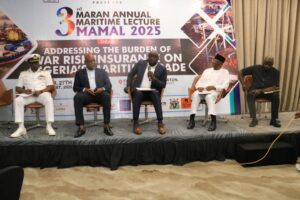
“For over four years, Nigeria has recorded zero piracy incidents due to sustained investments in maritime security under the Deep Blue Project. Yet, we are still made to pay billions in war risk insurance for a threat that no longer exists. This is unfair and must end,” Oyetola said.
He revealed that Nigeria has lost an estimated $1.5 billion in recent years to these premiums, despite achieving unprecedented reforms since the Ministry was established in 2023.
Among the milestones, he listed the elimination of the decades-long Apapa gridlock, the launch of Africa’s first National Policy on Marine and Blue Economy, and the Federal Executive Council’s approval of port modernization projects in Lagos, Tin Can Island, and the Eastern Ports.
According to him, maritime agency revenues more than doubled within two years from ₦700.79 billion in 2023 to ₦1.39 trillion in 2024 marking the highest revenue in Nigeria’s maritime history.
He also highlighted the unlocking of the Cabotage Vessel Financing Fund, the inauguration of a National Flag Carrier Technical Committee to establish a private-sector-led shipping line, and initiatives to strengthen food security through aquaculture and fisheries.
“In just two years, we have transformed Nigeria’s maritime landscape. Our waters are secure, our ports are modernizing, and our revenues are at historic highs. Yet, international underwriters continue to impose premiums on Nigerian-bound vessels based on outdated perceptions, Oyetola declared.
Oyetola emphasized that these achievements demonstrate Nigeria’s readiness to compete globally without the burden of outdated risk labels.
“Nigeria has earned its place as a safe and thriving maritime hub. The world must acknowledge this progress by removing the war risk premium. It is time to match perception with reality,” he concluded.