

Joyce Mmereole Okoli
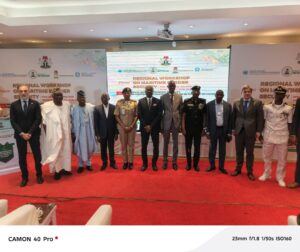
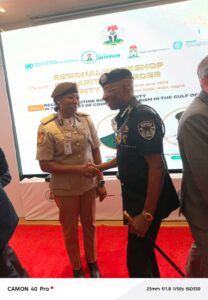
The Nigeria Immigration Service (NIS), in partnership with the United Nations Counter-Terrorism Centre (UNCCT), today kicked off a high-level regional workshop focused on maritime security and counter-terrorism efforts in the Gulf of Guinea (GoG).
The three-day event, held at the Sheraton Hotel in Lagos from May 20 to 22, brings together top security experts, regional stakeholders, and international partners to develop coordinated strategies against transnational maritime threats.
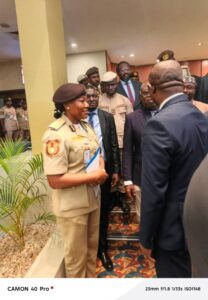
In her keynote address, the Comptroller-General of the NIS, Mrs. Kemi Nanna Nandap, stressed the urgent need for collective action to combat piracy, terrorism, human trafficking, and arms smuggling crimes that continue to threaten regional stability and economic growth.
“We must rethink and evaluate our approach to maritime security in light of evolving threats in the Gulf of Guinea,” Nandap said. She called for stronger investment in surveillance technology, improved intelligence sharing, and the formation of joint task forces to secure maritime borders.
Highlighting recent collaborative efforts, such as the April 2025 counter-terrorism meetings hosted by Morocco and Cabo Verde and the ECOWAS naval leadership summit in Praia, Nandap emphasized that regional momentum for security cooperation is growing.
The Gulf of Guinea, a vital maritime corridor rich in oil and gas remains one of the world’s most volatile maritime zones, plagued by piracy, illegal oil bunkering, and other criminal activities that have hindered international trade and economic development.
Nandap outlined the NIS’s ongoing efforts to expand its Border Management Information System (BMIS) to maritime borders and deploy Advance Passenger Information (API) and Passenger Name Record (PNR) tools for more effective threat detection.
“Our threats are transnational, and so must be our response,” she said, urging member states to uphold international conventions like the Yaoundé Code of Conduct and align efforts with Africa’s Agenda 2063 and the 2050 African Integrated Maritime Strategy.
Also speaking at the event, Comptroller-General of the Nigeria Customs Service, Bashir Adewale Adeniyi, emphasized the growing connection between terrorism, narcotics, and illicit financial flows in the Gulf of Guinea and Sahel region. He called for deeper collaboration among security agencies and the integration of financial intelligence into counter-terrorism strategies.
“All the terrorists operating along our shores are driven by narcosis. We must understand how they use the financial system to fund their activities.”
He advocated for the creation of credible terrorist databases and greater community engagement in coastal areas.
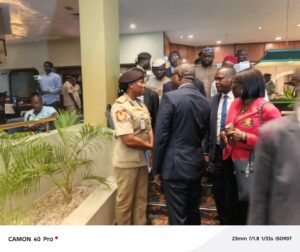
Adeniyi also praised the event’s focus on interagency cooperation, crediting recent improvements in Nigeria’s border management to reforms driven by the Ministry of Interior, including technology upgrades and improved passport services.
In his remarks, Minister of Interior Olubunmi Tunji-Ojo described the workshop as a pivotal step toward safeguarding Nigeria’s future. He identified maritime borders as Nigeria’s most porous and complex frontier, posing unique security challenges given the country’s strategic location at the intersection of the Sahel and the Gulf of Guinea.
With over 230 million citizens — 70% under the age of 40 — Tunji-Ojo stressed the importance of preventing the radicalization and exploitation of Nigeria’s youthful population by criminal and terrorist networks.
He revealed that the NIS is leading a comprehensive review of the country’s border security strategy, underscoring the urgency of implementation.
“The time for action is now,” the Minister declared. “Our focus is not short-term popularity but sustainable reform. We must build systems that outlast political cycles.”