

Joyce Mmereole Okoli
The International Maritime Institute of Nigeria (IMION) has launched a landmark Executive Course on the Blue Economy for media practitioners, aimed at bridging the gap between ocean policy and public awareness — even as experts at the event sounded the alarm over Nigeria’s failure to leverage its vast maritime potential.
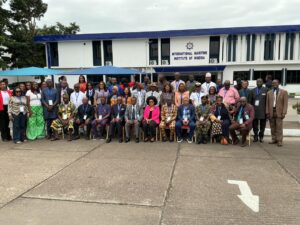
Held at the IMION headquarters, the one-day intensive training brought together journalists, maritime stakeholders, and policy experts to explore the role of the media in advancing marine sustainability and economic development.
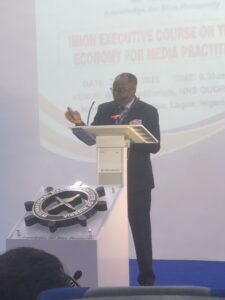
In his opening remarks, IMION Director General, Rear Admiral Thaddeus Christopher Udofia (Rtd), emphasized the media’s vital role in shaping public discourse and influencing maritime policy.
“The oceans sustain life, livelihoods, and entire economies, Yet, they are under increasing pressure from unsustainable practices and climate change. This is where you come in — not just as reporters, but as storytellers, watchdogs, and change agents,” Udofia noted.
The training focused on equipping journalists with the knowledge and tools to report accurately on maritime issues such as sustainable fisheries, ocean governance, blue energy, and marine conservation.
Udofia expressed appreciation to the Chief of Naval Staff, Vice Admiral Emmanuel Ikechukwu Ogalla, and legal firm Paul Usoro & Co. for their support in organizing the programme.
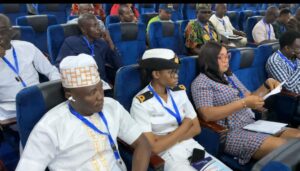
Delivering a goodwill message, Mr. Godfrey Bivbere, President of the Maritime Reporters Association of Nigeria (MARAN), praised the initiative, noting its potential to deepen understanding and foster collaboration between the media and maritime institutions.
“Sustained collaboration between maritime journalists and the Navy is vital in promoting transparency, national security, and the development of Nigeria’s Blue Economy,” Bivbere stated.
The training, however, took on a more urgent tone as prominent maritime stakeholders decried Nigeria’s chronic neglect of its waterways and coastal assets.
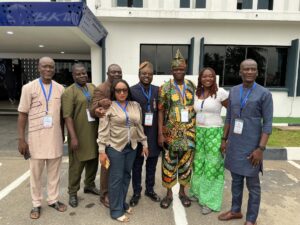
Rear Admiral Francis Akpan (Rtd), Chairman of the Maritime Security Providers Association of Nigeria (MASPAN), lamented the degradation of key marine zones like Tarkwa Bay and Bonny Island, which he described as among the world’s largest marine dumpsites.
“If you stand by the Seine River in Paris, you’ll count over 50 ferries. Our own lagoons? Practically deserted. There is widespread ignorance of the importance of maritime space even within academia and policy circles. That’s why we have poor investment and missed opportunities.”
Akpan underscored the strategic value of maritime power beyond military strength as a driver of diplomacy, investment, and national prosperity.
Dr. Obiora Madu, Founder of Multimix Academy, echoed similar concerns. He cited the collapse of Nigeria’s fishing industry and the rise of Lomé Port in Togo as evidence of Nigeria’s eroding regional competitiveness.
“Lomé’s growth as a maritime hub should wake Nigeria up from its slumber,” he warned.
Mrs. Funke Agbor (SAN), President of the Nigerian Maritime Law Association (NMLA), called for greater urgency in implementing Nigeria’s recently launched National Policy on the Blue Economy. She urged the media to champion a national reawakening around maritime potential.
“We are a beautiful coastal country, yet we act like we’re landlocked. Let’s not be discouraged. There is still time and hope to restore our waters and reclaim our marine wealth,” Agbor said.
Also in attendance was Barr. (Mrs.) Mfon Usoro, President of the Chartered Institute of Logistics and Transport (CILT) Nigeria and former Director General of NIMASA, whose presence underscored the importance of multisectoral collaboration.
The IMION training concluded with a collective call to action for journalists to help rewrite Nigeria’s maritime story not just as observers, but as key actors in shaping the nation’s blue future.