

Joyce Mmereole Okoli
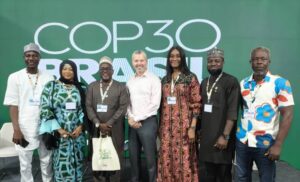
The Nigerian Maritime Administration and Safety Agency (NIMASA) has taken a major step toward maritime decarbonization by showcasing a groundbreaking Public Private Partnership (PPP) model for continuous emissions monitoring at the 2025 UN Climate Change Conference (UNFCCC COP30) in Belém, Brazil.
The Agency unveiled the Nigerian Maritime Continuous Emissions Monitoring System, a pioneering digital solution developed in collaboration with researchers from University College London (UCL). The presentation was made during a NIMASA-hosted side event, where Nigeria reaffirmed its commitment to advancing the International Maritime Organisation’s (IMO) energy transition strategies.
Speaking at the event, Director of Marine Environment Management, Dr. Oma Ofodile, who represented the Director General, Dr. Dayo Mobereola, said NIMASA’s consistent efforts toward maritime energy transition have culminated in this innovative initiative.
She noted that the Agency has remained “at the forefront of coordinated efforts in advancing the IMO energy transition strategies through digital innovation,” stressing that the new monitoring system would help transform global climate ambitions into measurable progress within Africa’s maritime sector.

NIMASA’s climate-action journey has evolved through successive COP engagements.
• At COP28, the Agency championed the creation of an African coalition for IMO greenhouse gas (GHG) emission reduction.
• At COP29, it convened expert panels and presented progress on developing a verifiable Nigerian maritime emissions inventory in partnership with the UCL research group.
• Now at COP30, the Agency formally introduced the continuous emissions monitoring platform, demonstrating Nigeria’s readiness for low-carbon shipping.
Representing the IMO Secretary General, Mr. Roel Hoeders applauded NIMASA for organizing a forward-looking session that offers strategic direction on how Africa can overcome challenges associated with shipping energy transition.
The event drew expert speakers and institutional representatives from the IMO, UCL, the maritime administrations of Ghana, Kenya, and Tanzania, the Lagos State Ministry of Planning and Budget, the Federal Ministry of Marine and Blue Economy, and the Nigerian Ports Authority (NPA), among others.
COP30 is expected to reach a landmark agreement on key indicators for measuring global progress under the Global Goal on Adaptation (GGA), a move that will refine a broad list of 100 indicators into a focused set aligned with the 11 targets of the GGA Framework established under the Paris Agreement.