

Joyce Mmereole Okoli
Nigeria’s historic ascension to the chairmanship of the World Customs Organization (WCO) Council must not be treated as a ceremonial milestone but rather as a strategic tool for economic transformation, trade facilitation, and continental leadership, freight forwarding expert and maritime industry stakeholder, Dr. Eugene I. Nweke, has said.
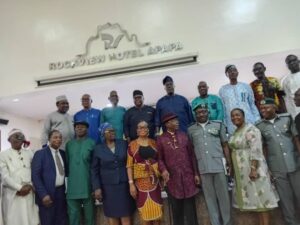
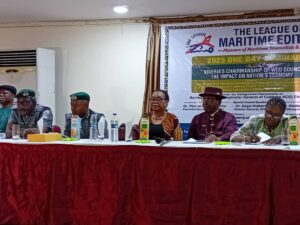
Delivering a keynote lecture at the League of Maritime Editors’ one-day seminar themed “Nigeria’s Chairmanship of WCO Council: The Impact on Nation’s Economy”held at Rock View Hotel, Apapa, Nweke represented by Francis Aneze Chukwu described the development as a prestigious yet powerful platform that places Nigeria at the center of global customs reforms.
“On July 1, 2025, Nigeria assumed the chairmanship of the WCO Council, a body representing over 180 customs administrations and covering 98 percent of global trade, This is not just a medal to display or a feather in our cap. It is an opportunity to harmonize African trade procedures, reform our ports, and position Nigeria as a continental trade hub. ” he noted.
Highlighting the stakes, Nweke observed that while the Nigeria Customs Service (NCS) generated ₦1.3 trillion in the first quarter of 2025, inefficiencies and delays at Nigerian ports still cost the country about $4 billion annually in lost revenue and competitiveness.
He commended reforms already introduced under the leadership of Comptroller-General of Customs, Bashir Adewale Adeniyi, listing among them:
- The Time Release Study (TRS) to address port delays;
- Data analytics for risk-based inspections;
- Advance ruling applications to ensure tariff clarity;
- The Authorized Economic Operator (AEO) scheme for trusted traders;
- The B’Odogwu single-window platform for trade facilitation; and
- Deployment of rapid scanners for faster, non-intrusive inspections.
“These reforms are not ends in themselves, but they form the springboard for maximizing Nigeria’s WCO chairmanship and for unlocking opportunities presented by the African Continental Free Trade Agreement (AfCFTA),” Nweke stressed. “
According to him, Nigeria’s new leadership position could accelerate AfCFTA implementation through harmonized customs procedures, mutual recognition of AEOs across Africa, adoption of international data standards, and wider deployment of Time Release Studies.
“This amounts to leadership with practical outcomes, emphasizing that Nigeria must not squander the moment. If we consolidate reforms, harness AfCFTA, enthrone transparency, and redefine fiscal policies, Nigeria will not only lead Africa in customs administration but stand tall as a continental beacon of trade and industrialisation, ” he said.
Nweke, however, issued a note of caution. He identified infrastructure deficits, policy inconsistencies, bureaucratic bottlenecks, and entrenched corruption as threats that could erode the benefits of Nigeria’s chairmanship if left unaddressed.
He proposed a number of solutions, including:
- Institutionalised data sharing among trade agencies;
- Scaling the AEO programme regionally;
- Sustaining scanner investments through
public-private partnerships; and
- Regular auditing of Customs’ performance metrics.
Turning to the role of the maritime press, Nweke charged journalists to deepen their engagement and become “professors of the maritime space.”
“You must educate stakeholders, interrogate reforms with data, shape narratives responsibly, and guide policy with analysis. Stop hyping undue praises that make us a collective ridicule,” he admonished.
In his goodwill message, Captain Iheanacho Ebubeogu, former General Manager, Corporate Affairs of the Nigerian Ports Authority (NPA), underscored the importance of collective support for the Comptroller-General of Customs and the institution at large.
Speaking during the seminar, Ebubeogu stressed that customs remains the first line of enforcement at the nation’s ports.
“The Nigerian Ports Authority is often seen as the visible face of the ports, but Customs is the enforcement authority. The first thing to be respected when you approach a port is that you are entering a customs-controlled border post. That is where fiscal regulations are enforced, trade is facilitated, and investment confidence is built,” he explained.
Congratulating Adeniyi on his new leadership role at the WCO, Ebubeogu cautioned that international platforms like the WCO are “a salad of interest, national, regional, and global where diplomacy and politics dominate.” He therefore urged stakeholders to remain vigilant and supportive, stressing that **national interest must remain the priority.
Drawing from his own experience in corporate affairs, he also emphasized the importance of reputation management in sustaining Nigeria’s credibility on the global stage.
“Now that our man is there, let us not bring him down. Let us manage his image and talk up his reputation so that by the time he leaves, he does so with his head held high,” he said.
Ebubeogu concluded with a rallying call: “As our representative takes on this responsibility, we must be determined to support him through the challenges, so that at the end of the day, Nigeria and indeed the region will be crowned with success.”
Earlier in her welcome address, Mrs. Remi Itie, President of the League of Maritime Editors, described Nigeria’s WCO chairmanship as “a historic moment that places Nigeria at the forefront of global customs reforms.”
She praised Adeniyi’s emergence as the first Nigerian to chair the council since its establishment in 1953, noting that the position allows Nigeria to influence global customs agendas on trade facilitation, revenue optimization, security, and digital transformation.
Beyond customs administration, Itie called on policymakers to harness Nigeria’s vast maritime potentials, seafaring, fishing, coastal tourism, and blue economy initiatives as additional levers for job creation and economic growth.
She also commended Minister of Marine and Blue Economy, Adegboyega Oyetola, as well as agencies such as NIMASA, the Nigerian Shippers’ Council, and the NPA for their contributions to the sector.
“Nigeria, as Africa’s largest black nation, has the natural resources to build jobs and industries through maritime. This is how countries like America, China, Singapore, and Indonesia transformed their economies,” she said.
The one-day seminar brought together senior customs officers, maritime regulators, industry captains, and media practitioners. Discussions centered on how Nigeria can turn its global leadership role into tangible national benefits.
For Nweke, the bottom line is clear: “The WCO chairmanship must be treated as a tool for transformation, not prestige. If Nigeria seizes this opportunity, the gains will go beyond customs to redefine our economic destiny.”